


【Client Alert】The JOLCO on Trial
FW Aviation v VietJet: Validity of the Termination Notices, Termination Sums Upheld (Not an Unenforceable Penalty Clause), and Enforcement from London to Singapore
Key Questions (FAQ) / Summary(Click to Expand)
It represents the primary real-world stress test validating JOLCO structures under financial default. The English and Singapore courts fully upheld lease termination validity, broad debt assignment rights, enforcement of ~US$181.5M termination sums (confirming they are not penalties), denial of relief from forfeiture, and recovery of actual restoration losses.
The court found the clause protected legitimate commercial interests—specifically safeguarding the Japanese equity investors' targeted returns and accelerated tax depreciation structure. The court emphasized that VietJet was a sophisticated commercial entity and ruled that termination sums remained fully payable even after the jets were repossessed and sold.
VietJet argued that FitzWalter (a distressed debt fund) was not a "financial institution" under facility agreements. The court rejected this narrow view, adopting a broad interpretation that validated transfers to secondary market debt purchasers. Facility agreements should explicitly contemplate transfers to funds and secondary buyers.
While a JOLCO lessee's purchase call option grants a proprietary interest to request relief, the court refused it because VietJet engaged in strategic non-payment despite having funds, flew the jets rent-free for nearly a year post-termination, and actively obstructed re-export through local interference.
The judgment confirmed that lease indemnity clauses function as a true "make-whole" mechanism. The lessor was awarded actual incurred costs for restoring aircraft to airworthy condition and redelivery compliance, as well as consequential losses for lost rental income while the jets were un-leaseable during restoration.
FWA sought registration in Singapore under the Reciprocal Enforcement of Foreign Judgments Act 1959 to execute against regional assets. In [2026] SGHC(A) 11, the Singapore Appellate Division dismissed VietJet’s service challenge, holding that substituted service depends solely on whether personal service is practical—foreign local law (Vietnamese law) is irrelevant.
EXECUTIVE SUMMARY
- The Japanese Operating Lease with Call Option (JOLCO) is a structure of Japanese investors’ capital deployment into commercial aviation (and shipping finance) and until COVID-19 it had rarely been stress-tested in open court. The litigation between FW Aviation (Holdings) 1 Limited, a Jersey vehicle of the London-based FitzWalter Capital group, and VietJet Aviation Joint Stock Company changed that, producing a run of judgments now regarded as the leading authority on how JOLCO risk allocation behaves under stress.
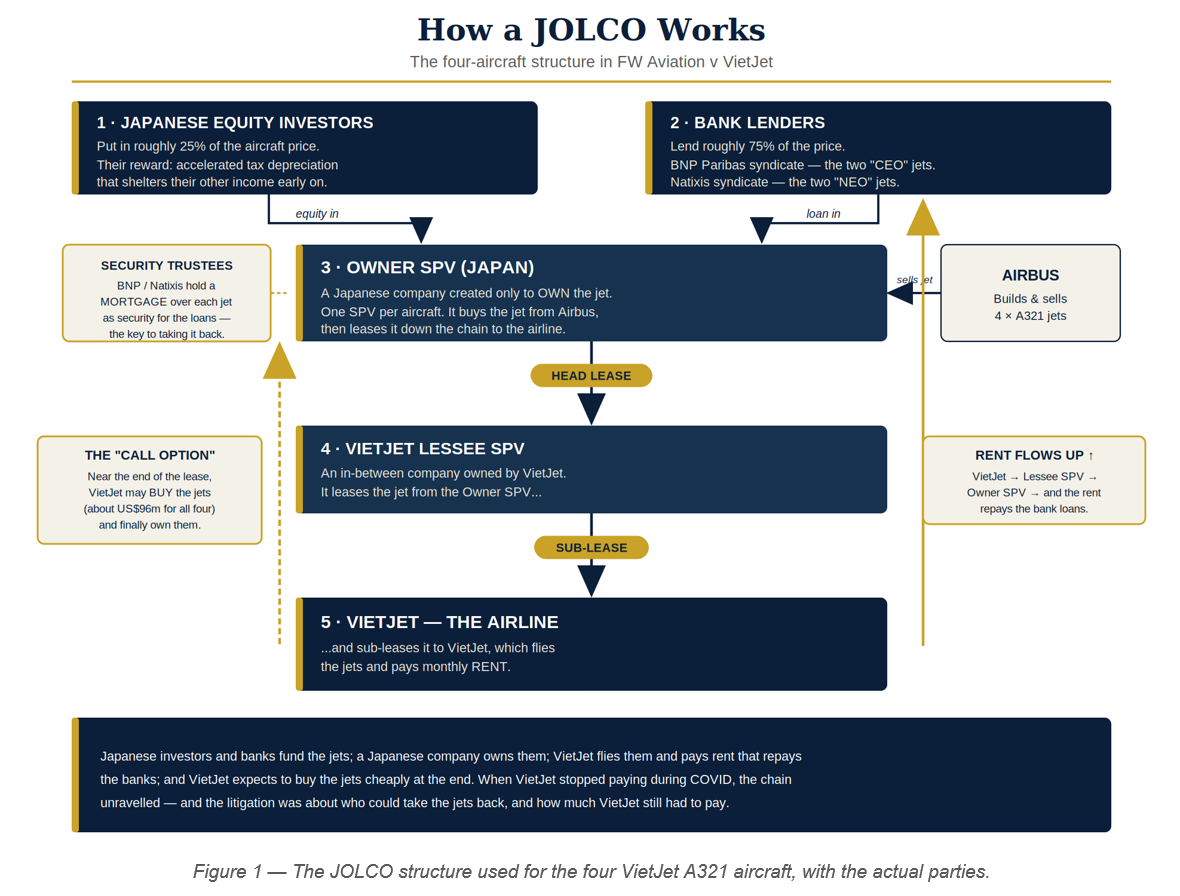
- A JOLCO stacks Japanese investor equity and bank debt inside a Japanese owner company that buys the jet, leases it down a chain to the airline, and lets the airline buy the jet cheaply at the end. The diagram shows exactly how the four VietJet aircraft were financed.
- Across six English judgments, affirmed by the Court of Appeal in June 2025 with permission to appeal to the Supreme Court refused in October 2025, the JOLCO structure was comprehensively upheld: the leases were validly terminated, the debt was validly sold on to a distressed-asset buyer, relief from forfeiture was refused, and roughly US$181.5 million in termination sums were held enforceable and not a penalty, even after the jets had been repossessed and sold.
- The English court also protected its own turf: it kept the fight in London by shutting down VietJet’s parallel Vietnamese proceedings, while declining to reach into Vietnam with mandatory orders out of respect for comity.
- VietJet did not pay, the English court declined to grant worldwide freezing relief, and the battle has moved to enforcement in Singapore.
- For Japanese investors, lenders, lessors, and Asian carriers across our corridor, this is now the leading real-world stress test of how JOLCO risk performs, and of how the creditor enforces.
I. What JOLCO is all about
The Japanese Operating Lease with Call Option (JOLCO) is a structure of Japanese investors’ capital deployment into commercial aviation, and until COVID-19 it had rarely been stress-tested in open court. The litigation between FW Aviation (Holdings) 1 Limited, a Jersey vehicle of the London-based FitzWalter Capital group, and VietJet Aviation Joint Stock Company changed that, producing a run of judgments now regarded as the leading authority on how JOLCO risk allocation behaves under stress.
Although FitzWalter is a fund rather than a Dublin lessor, the case has been followed intently by the Irish aircraft leasing community, whose portfolios carry large volumes of JOLCO-financed aircraft and whose own pandemic-era repossession experience in Vietnam mirrored the frictions exposed here. Had VietJet’s penalty challenge succeeded, the shock would have travelled across the whole market: a finding that termination sums were unenforceable could have triggered illegality-based termination events in JOLCO deals worldwide.
Ⅱ. How JOLCO Works
Strip away the acronyms and a JOLCO is a chain of promises built around one aircraft. Money comes in from two directions: Japanese investors put in roughly a quarter of the price as equity (their real prize is an accelerated tax deduction), and a bank syndicate lends the other three-quarters as debt. That money flows into a Japanese special purpose vehicle: a shell company created for the sole purpose of owning the jet, which buys the aircraft from the manufacturer. The owner company then leases the jet, via an intermediate company, down to the airline that flies it. The airline pays rent; the rent travels back up the chain and repays the bank loan. At the end, the airline can exercise a purchase option, the “call option”, and buy the jet at a pre-agreed price, becoming its owner.
Two features do the heavy lifting when things go wrong. First, the banks take a mortgage over the jet, held through a security trustee, that mortgage is what ultimately lets the financiers seize and sell the aircraft. Second, because the airline holds a call option, it has more than mere possession; it has a proprietary stake in the jet, which is why an airline in default can at least ask a court for “relief from forfeiture.” Both features are central to the VietJet story.
Ⅲ. The Transactions and the Default
In 2018 and 2019, VietJet took delivery of four Airbus A321 aircraft: two newer “NEO” jets and two “CEO” jets, each financed by its own JOLCO combining roughly 25 per cent Japanese equity with 75 per cent bank debt. A BNP Paribas-led syndicate financed the two CEO aircraft; a Natixis-led syndicate financed the two NEOs, with each bank also acting as security trustee. Each jet sat in a Japanese owner SPV, was head-leased to a VietJet-owned intermediate company, and was sub-leased to VietJet as operator. Purchase options across the four aircraft came to roughly US$96 million.
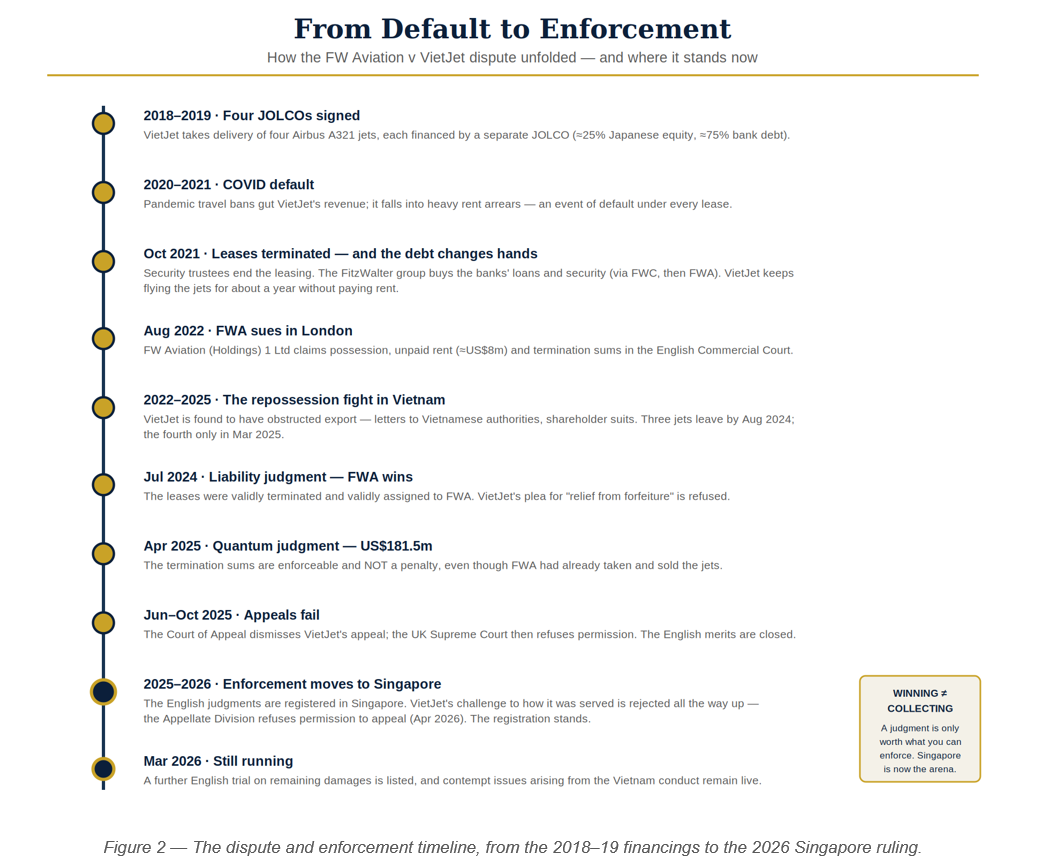
The pandemic gutted VietJet’s revenues, and by 2021 it was in heavy arrears across all four structures. In October 2021 the security trustees served termination notices. VietJet disputed them and kept flying the aircraft, rent-free, for about a further year. In the same window the lenders sold their positions to FitzWalter Capital Partners (Financial Trading) Limited, a newly incorporated English company, which was appointed security trustee and then assigned the loans and security to FW Aviation. FWA enforced the mortgages, took the aircraft through associated entities, and in August 2022 sued in the English High Court (Commercial Court) for possession, unpaid rent of about US$8 million, and termination sums exceeding US$180 million. Repossession proved slow and bitter: three jets were exported from Vietnam by August 2024, the fourth only in March 2025, against what the court later found was an orchestrated campaign of interference.
Ⅳ. The Dispute, Judgment by Judgment
The English proceedings generated a sequence of rulings. Rendered in plain terms below:
[2024] EWHC 1823 (Comm), 16 Jul 2024: Can the settlement talks be used as evidence?
Before trial, VietJet asked the court to remove parts of FWA’s pleadings that quoted confidential settlement discussions. FWA argued VietJet had effectively threatened, in those talks, to make enforcement in Vietnam impossible, and that such “unambiguous impropriety” should strip away the usual “without prejudice” confidentiality. The judge disagreed: the remarks were better read as a candid warning about the practical difficulty of enforcing in Vietnam, not a threat to defy the courts, and were not blackmail. The discussions stayed confidential. The takeaway for clients is that frank settlement talk is well protected, and the bar for treating hardball language as “impropriety” is high.
[2024] EWHC 1904 (Comm), 26 Jul 2024: Stopping interference, but only so far.
FWA already held a 2022 consent order giving it possession, custody and control of the jets. It complained that VietJet-linked shareholder suits and correspondence in Vietnam were being used to frustrate deregistration and export, and asked the court to rein VietJet in, including a mandatory order forcing VietJet to write to the Vietnamese claimants. The court granted several prohibitory (“don’t do this”) orders but refused the mandatory (“you must do this”) one, stressing the difference between the two and the need for comity with the Vietnamese courts and the pending contempt proceedings. The English court will guard its own orders but hesitates before directing a party’s conduct inside a foreign forum.
[2024] EWHC 1945 (Comm), 31 Jul 2024: FWA wins on liability.
This is the central liability judgment. Three findings mattered most. First, the October 2021 termination notices validly ended the leasing. Second, the chain of assignments to the FitzWalter entities was valid, so FWA had standing to sue. VietJet’s argument that a distressed-debt buyer was not a “financial institution” failed, the court reading that term broadly. Third, VietJet’s counterclaim for relief from forfeiture, asking the court, in effect, to hand the jets back or force a fresh lease, was refused, because VietJet had defaulted heavily despite being able to pay and had obstructed repossession. The judge also criticized VietJet’s letters to Vietnamese authorities as an attempt to interfere with export.
[2024] EWHC 3337 (Comm), 23 Dec 2024: Keep the fight in London courts.
VietJet had started proceedings in the People’s Court of Hanoi against the original banks, BNP and Natixis. FWA and the banks sought anti-suit injunctions, since every key agreement: loan, head lease and sub-lease, required disputes to be resolved in England. The court agreed the banks could rely on those exclusive-jurisdiction clauses even though they had sold on their rights, but rather than impose an injunction it accepted formal undertakings from VietJet not to pursue the Vietnamese proceedings, a lighter touch on international comity. The English forum-selection clauses held, and the parallel foreign litigation was shut down.
[2025] EWHC 928 (Comm), 17 Apr 2025: How much, and is it a penalty?
The quantum trial fixed the numbers: about US$164.8 million in termination sums plus about US$16.7 million in post-termination “rental” for NEO aircraft not returned in the agreed condition, roughly US$181.5 million in all. VietJet argued the termination clause was in the nature of an unenforceable penalty. The court disagreed: the sums protect genuine interests, including the Japanese investors’ returns and their tax position, which is accelerated and worsened if the JOLCO collapses early, and VietJet was a sophisticated party that had negotiated the deal knowingly. Crucially, the sums remained payable even though FWA had already repossessed and sold the aircraft.
[2025] EWCA Civ 783, 24 Jun 2025: The Court of Appeal affirms.
VietJet appealed the liability findings. On 24 June 2025 the Court of Appeal dismissed the appeal in full, upholding the validity of the termination notices and the broad reading of “financial institution” that had validated the transfers to the FitzWalter entities. Permission to appeal to the Supreme Court was refused on 30 October 2025, rendering the English merits rulings final.
[2025] EWHC 1920 (Comm), 23 Jul 2025: Winning isn’t enforcement or collecting.
The judgment debts fell due on 15 May 2025 and went unpaid, even though VietJet had told the court it was taking “active and urgent steps” to raise the money. FWA sought a worldwide freezing order, alleging a risk that assets would be placed beyond reach, but the court refused it: VietJet had participated fully in the hard-fought litigation since 2022, and the evidence did not establish a real risk of dissipation. The episode is a double reminder: a favourable judgment is only the first step among many, and freezing relief remains hard to obtain even against a non-paying judgment debtor. That grind is precisely what pushed FWA toward enforcement in Singapore.
[2025] EWCA Civ 1458, 14 Nov 2025: A narrow win for VietJet on contempt.
One appellate ruling did go VietJet’s way. FWA had pursued contempt proceedings over VietJet’s letters to Vietnamese public authorities, arguing that they undermined the injunction protecting FWA’s possession of the aircraft. On 14 November 2025 the Court of Appeal held that a party cannot be liable in criminal contempt for conduct that offends only the spirit, and not the letter, of an injunction. The drafting lesson is immediate: an injunction must expressly prohibit the specific conduct feared, because the court will not stretch its wording after the event.
[2026] EWHC 1996 (Comm), KBD, 31 July 2026: Recoverability of indemnity-based losses beyond the rental default and what "actual loss" means for a Japanese lessor-investor post-termination.
The central question before Mr. Justice Birt in this third trial was one of contractual interpretation of the indemnity provisions in the JOLCO lease documentation, specifically, the scope of the lessee's (VietJet's) obligation to compensate the lessor (FWA) beyond simply the unpaid rent that triggered termination. The Court confirmed that the indemnity extended to (a) the actual, incurred costs of restoring the NEO aircraft to airworthiness and re-exporting them following redelivery, and (b) consequential loss in the form of rental income foregone while the aircraft sat un-leasable during that restoration period. VietJet's counterclaim, presumably challenging either the scope of the indemnity or the reasonableness/causation of these costs, was dismissed outright.
Ⅴ. Enforcing the Judgment: From London to Singapore
The most instructive part of this saga is not the win in London but the grind of turning that win into recovery. An English money judgment does not enforce itself against a Vietnamese airline; the creditor must find a forum where the debtor has assets or a presence and persuade that forum to recognise and execute the judgment. FWA has made Singapore its enforcement jurisdiction, and the process has been contested at every step.
Registering the English judgments
In June 2025 FWA applied to register the English orders in Singapore under the Reciprocal Enforcement of Foreign Judgments Act 1959, and on 1 July 2025 the Singapore High Court granted registration. Registration is what converts a foreign judgment into something a Singapore court will enforce, the essential first step before any execution against assets.
The fight over service
VietJet’s resistance then shifted to a procedural row: how it was served. FWA first tried to serve the registration papers personally in Vietnam through DHL courier in mid-July 2025; both attempts failed. On 1 August 2025 the court permitted substituted service by email. VietJet applied to set that order aside, arguing that service by courier and email did not comply with Vietnamese law and that the papers lacked a Vietnamese translation. In December 2025 the Deputy Registrar dismissed the set-aside application but, out of caution, directed FWA to re-serve a translated set of documents. VietJet appealed to the General Division, which dismissed the appeal, and then sought permission to appeal again.
[2026] SGHC(A) 11 in Singapore
On 21 April 2026 the Appellate Division refused VietJet permission to appeal. Its reasoning is a clean statement of Singapore practice: the only question governing substituted service out of Singapore is whether personal service is impractical, not whether the earlier service attempts were valid under the foreign law of the place of service. Vietnamese law was simply irrelevant to that question, and the evidence showed VietJet’s representatives were at least making service difficult, if not evading it outright. The intended appeal amounted to a challenge to findings of fact, which is impermissible save in exceptional cases, and none existed. The result: the registration stands, and VietJet’s procedural maneuvering to unwind it is exhausted. Three lessons follow for our clients. Singapore’s registration regime gives creditors of Asian obligors a credible enforcement platform even where the debtor holds few local assets, because aircraft transit Changi and commercial counterparties bank here. Procedural skirmishing over service on Vietnamese entities is entirely foreseeable and should be budgeted for; the courts will insist on proper translations but will not let technical objections defeat registration.
Ⅵ. Implications for the Market Players
- Japanese equity investors. The structure’s tax rationale is now part of English remedies analysis — the penalty doctrine was applied with full sensitivity to the accelerated-depreciation bargain that motivates Japanese equity. Structure memoranda and recitals should articulate those interests clearly, since they may one day anchor the enforceability of the termination waterfall.
- Lenders and arrangers. Broad assignment language pays for itself. The “financial institution” dispute consumed years of litigation that clearer transfer provisions would have avoided. Facility agreements should expressly contemplate transfers to funds, SPVs, and secondary purchasers of distressed debt.
- Lessors, including the Irish platforms. Termination machinery survives repossession and sale, and post-termination rental can operate as enforceable liquidated damages for redelivery shortfalls. That strengthens every financier’s hand, including the Dublin-based lessors with heavy exposure in the region, but the drafting of post-termination rental clauses now deserves fresh attention.
- Airline lessees. The call option is a genuine equity, and English courts will recognise a proprietary interest capable of grounding relief from forfeiture, but that protection is forfeited by strategic non-payment and obstruction. An airline in distress preserves far more options by engaging early and negotiating a standstill than by contesting termination while flying the jets rent-free.
- Indemnity-based losses. For Japanese investors and arrangers in a JOLCO structure, the 31 July 2026 judgment confirms that the indemnity mechanism is not limited to a rent-substitution measure of damages but functions as a genuine "make-whole" for the SPC/lessor's actual downstream costs of re-commercializing repossessed assets (i.e. airworthiness restoration, export compliance, and lost re-leasing income during the gap period). This matters directly to the risk allocation Japanese equity investors underwrite at deal inception. It validates that carefully drafted indemnity language in the JOLCO lease can transfer asset-condition and remarketing risk onto a defaulting lessee even after termination, rather than leaving the SPC (and its Japanese investor) to absorb restoration costs as an uncompensated capital loss. It also emphasizes the importance of precise indemnity drafting and contemporaneous cost documentation, since the Court's approach rewarded FWA's ability to evidence "losses actually incurred" rather than relying on a formulaic damages calculation.
(By: Earl Rivera-Dolera, Mitsuyuki Okuyama, Yosuke Aoki)
*This briefing is provided for general information only and does not constitute legal advice. It draws on the publicly available judgments in FW Aviation (Holdings) 1 Ltd v VietJet Aviation Joint Stock Company [2024] EWHC 1823 (Comm), [2024] EWHC 1904 (Comm), [2024] EWHC 1945 (Comm), [2024] EWHC 3337 (Comm), [2025] EWHC 928 (Comm) and [2025] EWHC 1920 (Comm); the appellate decisions [2025] EWCA Civ 783 and [2025] EWCA Civ 1458; the UK Supreme Court’s refusal of permission to appeal (30 October 2025); and VietJet Aviation Joint Stock Company v FW Aviation (Holdings) 1 Ltd [2026] SGHC(A) 11. Positions are current as at July 2026. © 2026 TKI Singapore LLP.

TKI (Singapore) LLP
earl.dolera@tkilaw.com
Earl Rivera-Dolera is an international dispute resolution specialist who has handled over 200 international matters with total claims exceeding US$10 billion. Former Partner and Head of International Arbitration at Frasers Law Company (formerly Freehills) in Vietnam and arbitrator at The Arbitration Chambers (Singapore), she brings multi-jurisdictional qualifications and extensive advocacy experience across Asia-Pacific, Europe, and London courts.
Core Practice Highlights
- International Arbitration: Acts as counsel and sits as an arbitrator (sole, party-appointed, tribunal chair) and empaneled as arbitrator and mediator under major institutional rules including ICC, SIAC, JCAA, and HKIAC, Resolution Institute (Australia and New Zealand), LCIA, KCAB, AAA-ICDR, CAA, THAC, AIAC.
- Aviation & Asset Lease Disputes: Advised Dublin-based lessors and international financiers on defaulted aircraft lease agreements, enforcement strategies, and associated litigation before the English courts in London.
- Energy, Infrastructure & Cross-Border Disputes: Represents multinational clients in complex commercial, construction, and infrastructure claims across borders.
Bar Admissions & Qualifications: Solicitor (England & Wales) | Attorney-at-Law (New York, Texas, Philippines)
Professional Affiliations: Fellow, Chartered Institute of Arbitrators (FCIArb) | Fellow, Singapore Institute of Arbitrators (FSIArb)

Mitsuyuki Okuyama is a Japanese-qualified attorney (Bengoshi) with over 13 years of practice experience at top-tier law firms (including Mori Hamada & Matsumoto) and TKI. Dual-credentialed as a licensed Second-Class Architect, he combines legal expertise with technical acumen to advise on complex finance, energy, infrastructure, and real asset transactions.
Core Practice Highlights
- Aviation & Airport Infrastructure: Advises Japanese and international parties on commercial aircraft leasing and financing structures, security arrangements, and aviation-related land-use disputes. Worked on national airport concession (PPP) projects during his secondment to Japan's MLIT, covering scheme design, bidding documentation, cross-border negotiations, and operational phase support.
- Structured & Project Finance: Represents lenders and sponsors in renewable energy, real estate, and asset-backed financing transactions.
- Energy, Real Estate & Construction: Provides end-to-end counsel on project development, regulatory compliance, land acquisition, and construction contracts.
Bar Admissions & Credentials: Attorney-at-Law, Japan (Tokyo Bar Association) | Licensed Second-Class Architect, Japan | Licensed Real Estate Transaction Agent, Japan

Associate
yosuke.aoki@tkilaw.com